
Editor's Note: Please note that the Keeley Vatican Symposium has been postponed due to the passing of Pope Francis. No new date has been set. We are expecting to hear a similar announcement regarding all events that involved cardinals in this conference. Thank you for your understanding.
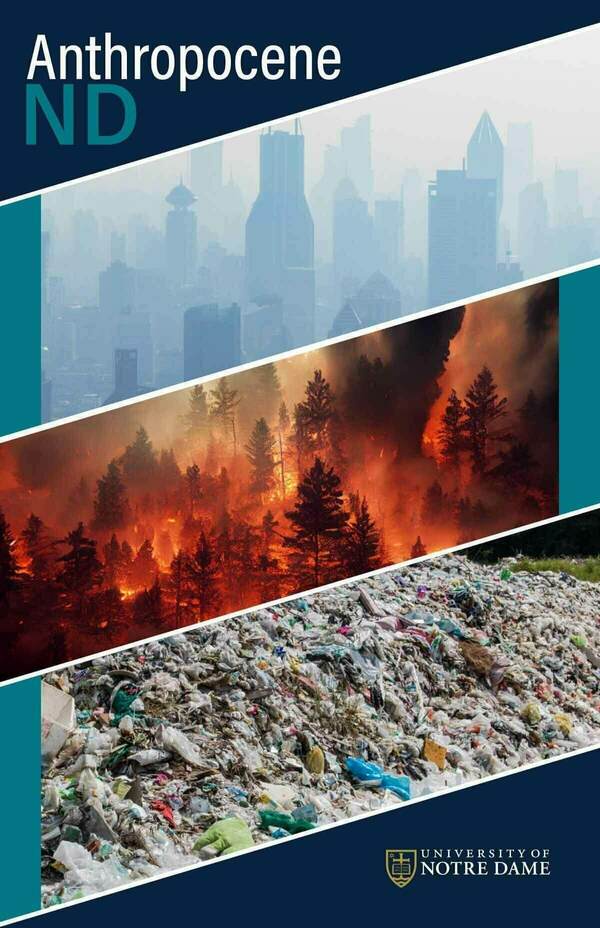
On April 24 and 25, the University of Notre Dame will host a conference called Anthropocene ND. This conference includes three public events that focus on the Anthropocene, the newly destabilized and still evolving state of our planet that is threatening the survival of many species, including our own. Julia Adeney Thomas and Brad Gregory, professors of history at Notre Dame, are organizing this conference.
The concept of the Anthropocene arose in Earth System science as a means of summing up Earth’s rapid mid-20th-century lurch away from the relatively stable Holocene epoch of the past 11,700 years to today’s unpredictable planetary condition. Our dangerous predicament is not just a scientific and technological problem, but as Pope Francis and many others have made clear, it poses unprecedented political, economic, cultural, and ethical challenges.
Ten years ago, in his encyclical Laudato Si’, Pope Francis wrote that “The destruction of the human environment is extremely serious, not only because God has entrusted the world to us men and women, but because human life itself is a gift which must be defended from various forms of debasement” (§5) These three events will highlight connections between the global reach of the Roman Catholic Church and the global character of the planetary environmental challenges we face. All those who care about the Church, the health of our planet, or the future of humanity are encouraged to attend.
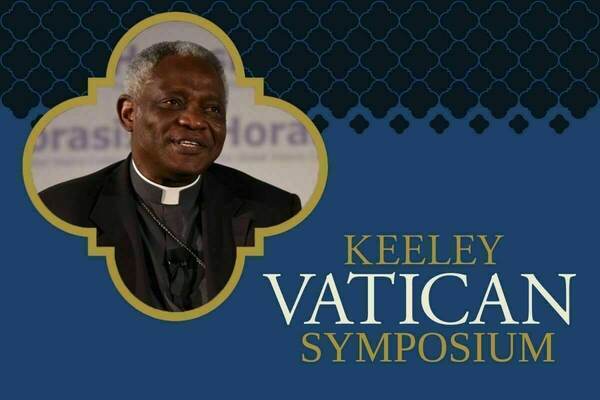
The Keeley Vatican Symposium on the theme of “The Catholic Church and the Anthropocene: Science, History, Hope,” will be held on Thursday, April 24, in the Decio Theatre of the DeBartolo Performing Arts Center from 3:30-5 p.m. This event follows the September 2024 conference at the Vatican on “Sciences for a Sustainable Anthropocene,” which was convened by Cardinal Peter Turkson of Ghana, the Chancellor of the Pontifical Academy of Sciences and the Pontifical Academy of Social Sciences. In this symposium, Cardinal Turkson will be joined by two other panelists from last fall’s Vatican conference: the Canadian geologist Francine McCarthy (Brock University) and the German historian of science Jürgen Renn (Max Planck Institute of Geoanthropology). Professors Thomas and Gregory will introduce the theme of the symposium, and Clemens Sedmak, director of the Nanovic Institute for European Studies, will lead the three participants in discussion with time for questions from the audience. This event’s lead sponsor is the Nanovic Institute through its Keeley Vatican Lecture series. A reception will follow this Keeley Vatican event.

On Friday, April 25, from 9-10:30 a.m., Ellis Adjei Adams, associate professor of geography and environmental policy at the Keough School of Global Affairs, will lead a multidisciplinary roundtable workshop in room C103 of the Hesburgh Center on the theme of “Africa and the Anthropocene.” It will feature Cardinal Peter Turkson in discussion with several Notre Dame faculty with expertise in issues pertaining to Africa, including Arun Agrawal, the inaugural director of Notre Dame’s Just Transformations to Sustainability Initiative; Melissa Berke (civil/environmental engineering and Earth sciences); Catherine Bolton (anthropology and peace studies); Bernard Forjwuor (Africana studies); and Rahul Oka (global affairs and anthropology). Recognizing that regions of the world that have done the least to bring about the Anthropocene are among those most harmed by its effects, this discussion will consider some of the grave problems faced by the African continent in the Anthropocene, including drought, waning biodiversity, novel zoonotic diseases, natural resource exploitation, agrarian land loss, rising population, and poor governance.
On Friday, April 25, from 11:30 a.m. to 1:00 p.m., a Notre Dame Forum event, sponsored by the Office of the President, will be held in the Smith Ballroom of the Morris Inn. As part of this year’s theme “What do we owe each other?”, University President Rev. Robert A. Dowd, C.S.C., will engage with Cardinal Peter Turkson of Ghana and Cardinal Pedro Barreto of Peru on the theme, “Ten Years after Laudato si’: Faith, the Anthropocene, and Justice in the Global South.” A decade after Pope Francis’s pioneering encyclical, how should the Catholic Church address the world’s radical socioeconomic disparities and prospects for human flourishing with respect to the historical trajectories that have brought them about? This public event is a rare opportunity to hear from Cardinals from two different continents, both of whom have been deeply involved in issues pertaining to the environment and social justice, on Notre Dame’s campus.
All three events are open to all members of the Notre Dame community as well as to members of the public at large.
The Anthropocene ND conference is generously sponsored by the Cushwa Center for the Study of American Catholicism, the Department of History, the Henkels Lecture Fund of Institute for Scholarship in the Liberal Arts, the John J. Reilly Center for Science, Technology and Values, the Kroc Institute for International Peace Studies, the McGrath Institute for Church Life, the Nanovic Institute for European Studies, and Notre Dame Energy.
Originally published by at nanovic.nd.edu on April 16, 2025.